- Home
-
Shop By Brand
Shop By Top Brands
View All Brands -
Interior
Interior
Browse All Interior Featured Category
Interior
-
Exterior
Exterior
Browse All Exterior Featured Category
Exterior
-
Paint Care
 Featured Category
Paint Care
- Detailing & Accessorie
- Pages





Mini Car Polisher vs Full Size Polisher | When to Use
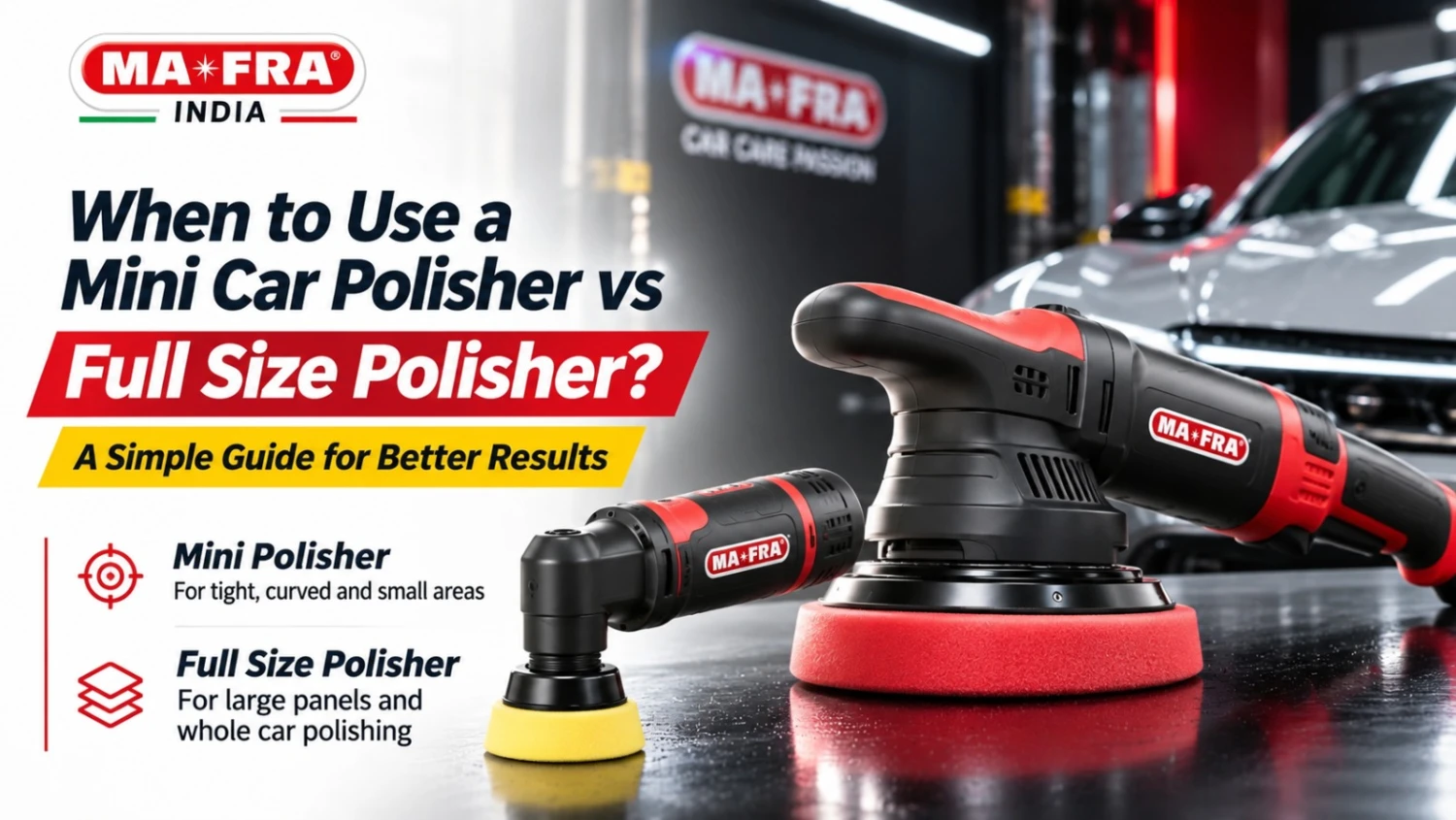
When Should You Use a Mini Car Polisher Instead of a Full Size Polisher?
Polishing a car is not just about removing scratches or making the paint shine. Using the right machine also matters.
A full size car polishing machine works well on large areas such as the bonnet, roof and doors. But what happens when you need to polish a narrow pillar, bumper corner or the area around a door handle?
A large polishing pad may not fit properly in these places. It can also touch nearby plastic trims or make the job difficult.
This is where a mini car polisher becomes useful.
A mini polisher helps you work on small, curved and hard-to-reach areas with better control. But it cannot replace a full size machine for every polishing job.
In this guide, we will explain when to use each machine, how they differ, what pads to choose and how to get better polishing results.
Quick Answer – When Should You Use a Mini Car Polisher?
Use a mini car polisher when you need to polish small or narrow areas where a full size polishing machine cannot work comfortably.
Mini polishers are useful for door handle areas, mirror caps, bumper corners, narrow pillars and small paint defects.
For larger panels such as the bonnet, roof and doors, a full size car polisher is usually the better choice.
The easiest way to decide is to look at the surface. If a large polishing pad cannot sit properly on the area, a smaller machine may give you better control.
What Is a Mini Car Polisher?
A mini car polisher is a compact machine used for polishing smaller sections of a vehicle.
Many mini polishers work with pads around 1 to 3 inches, depending on the machine and its supported backing plate.
These small pads help the operator reach narrow areas without covering too much surrounding paint.
Mini polishers are commonly used for spot correction, finishing small panels and working around vehicle details.
For example, a professional detailer may use a full size machine to polish a car door and then switch to a mini polisher to work around the door handle.
Both machines have different purposes.
You can explore the mini polishing system available through Mafra India to understand the type of tool used for precision detailing work.
Different Types of Mini Car Polishers
Not every mini polisher works in the same way.
Mini Dual Action Polisher
A mini dual action polisher combines rotation with an orbital movement.
This movement can make the machine easier to manage during light paint correction and finishing.
It is often a practical choice for people learning machine polishing.
However, incorrect pad selection, excessive pressure or repeated polishing can still damage paint.
Mini Rotary Polisher
A mini rotary polisher spins its pad around a fixed centre.
It can provide strong correction on a small area when used with a suitable pad and compound.
Because rotary machines can generate heat quickly, they require careful control, especially around edges and plastic parts.
Mini Cordless Polisher
A mini cordless polisher works with a rechargeable battery.
It is useful when you need to move around a vehicle without managing a power cable.
Some models support both rotary and orbital polishing.
For example, Mafra India lists a mini cordless polisher with rotary, 3 mm orbit and 12 mm orbit options.
Always check the supported accessories and machine instructions before use.
Mini Car Polisher vs Full Size Car Polisher
Both machines help improve the appearance of car paint, but they work best in different situations.
A mini polisher gives you more control in limited spaces.
A full size machine allows you to work across large panels more efficiently.
For professional car detailing, using both types can help achieve a more consistent result.
8 Situations Where a Mini Car Polisher Works Better
1. Polishing Around Door Handles
Door handle areas often develop small scratches and swirl marks.
These marks can appear from regular use, fingernails, keys and contact with other objects.
A large polishing pad may not fit inside the recessed area behind a handle.
A mini car polishing machine can make this work easier when the pad fits safely.
For very narrow recesses, hand polishing may still be the better option.
Start with a gentle polish and inspect the paint before trying stronger correction.
2. Polishing Bumper Corners
Car bumpers contain several curves and narrow sections.
A full size machine may not maintain proper pad contact on these surfaces.
A mini polisher can work better on smaller curves and corners.
However, painted plastic bumpers require care because heat can build up during machine polishing.
Avoid staying in one place for too long. Follow the machine manufacturer's recommended speed and pressure.
3. Removing Light Swirl Marks From Small Areas
Sometimes a car does not need complete paint correction.
You may only notice swirl marks around a small section of the vehicle.
For example, one corner of the boot lid may have visible marks while the surrounding paint remains in good condition.
A mini polisher can help treat the affected area without polishing the entire panel unnecessarily.
First, inspect the defect and test a mild polishing combination.
Remember that some scratches are too deep to remove safely through polishing.
4. Polishing Narrow Car Pillars
A-pillars and painted B-pillars can be difficult to polish with larger machines.
These areas may be narrow and located close to rubber seals, glass and plastic trims.
A small polishing pad gives you more room to work.
Mask nearby parts before polishing.
If the surface is glossy plastic rather than painted metal, check whether machine polishing is suitable for that material.
5. Polishing Mirror Caps
Mirror caps are small and curved.
A large polishing pad may extend beyond the panel and make it difficult to maintain control.
A mini polisher can make the job easier.
Use a soft polishing pad for light defects and follow the surface manufacturer's care instructions.
On delicate painted or plastic parts, work gently and check the finish frequently.
6. Polishing Around Badges and Small Details
Car badges and nearby painted sections can collect dirt and develop small marks.
These areas are difficult to reach with a full size machine.
A mini polisher may help on the accessible painted sections around a badge.
Do not force a moving pad into narrow gaps.
A small hand-polishing applicator is often more suitable for areas directly beside raised badges and trim.
7. Restoring Headlight Clarity
A suitable mini polisher can help improve the clarity of some plastic headlight lenses.
Its smaller pad can follow the curved shape of the lens.
However, headlight restoration requires the correct method for the lens condition.
Some headlights have protective coatings that should not be polished away unnecessarily.
If the original protective layer has been removed during restoration, suitable UV protection is important.
For badly damaged or uncertain lenses, professional restoration is recommended.
8. Polishing Motorcycles and Small Vehicle Panels
Motorcycles have smaller body panels than most cars.
Fuel tanks, painted side panels and fairings often contain tight curves.
A mini polisher can be useful in these areas.
The same applies to small spoilers, narrow painted trims and other compact vehicle parts.
Always confirm that the surface and its finish are suitable for polishing.
When Should You Choose a Full Size Car Polishing Machine?
A mini polisher is useful, but it is not always the right choice.
A full size car polishing machine is generally better when you need to work on a large area.
Polishing the Bonnet
The bonnet is one of the largest painted panels on a car.
A full size polishing machine covers more surface in each pass.
This can help you maintain a consistent finish while reducing unnecessary working time.
Polishing the Roof
Car roofs contain large areas that are easier to manage with a full size machine.
Using a mini polisher across the entire roof would require many more passes.
Polishing Large Door Panels
Most car doors have enough space for a standard polishing pad.
A full size machine is generally better for the main painted area.
You can then switch to a mini polisher for narrow sections around handles and edges.
Complete Car Paint Correction
If the entire vehicle has swirl marks, oxidation or other correctable paint defects, a full size machine is usually more practical.
Professional detailers may use different car polishing machines depending on panel size and paint condition.
How to Use a Mini Car Polisher Correctly
A mini polisher may be smaller, but good technique is still important.
These basic steps can help you work more carefully.
Step 1 – Clean the Surface
Wash the affected area and remove visible dirt.
Dry the surface using a clean microfiber towel.
If the paint has bonded contamination, use an appropriate decontamination method before polishing.
Polishing over dirt can create additional scratches.
Step 2 – Inspect the Paint
Look at the paint under suitable lighting.
Check whether the defect is a light swirl mark, surface haze or a deeper scratch.
Do not assume every mark can be safely removed.
Paint thickness and previous repairs can affect how much correction is possible.
Step 3 – Protect Nearby Trims
Mask sensitive rubber, plastic and other nearby surfaces where required.
Pay particular attention to narrow edges and raised body lines.
Step 4 – Choose the Correct Pad
Different polishing pads are designed for different jobs.
A cutting pad is used for stronger correction.
A polishing pad is used for lighter correction and improving gloss.
A finishing pad is used for surface refinement.
You can compare different sizes and grades in the car polishing pads collection on Mafra India.
Choose a pad that is approved for your machine and backing plate.
Step 5 – Start With a Test Spot
Before polishing the complete area, test a small section.
Use the least aggressive pad and polish combination likely to work.
Inspect the surface after the test.
If the finish improves without unwanted haze or marks, continue carefully.
Step 6 – Apply a Suitable Amount of Polish
A smaller pad usually needs less polish than a larger pad.
Follow the product instructions for the correct amount.
Using too much product can cause pad loading and make the finish harder to inspect.
Step 7 – Work on a Small Section
Place the pad correctly against the surface and follow the machine's operating instructions.
Use controlled, overlapping movements.
Avoid excessive pressure.
Pay close attention to curved surfaces and painted plastic parts.
Step 8 – Check the Result
Stop the machine and wipe away the polish residue using a clean, soft microfiber towel.
If required, use a compatible paint inspection product according to its instructions.
Inspect the finish under proper lighting.
Do not continue polishing if the paint becomes excessively warm or the surface shows signs of damage.
Step 9 – Clean or Change the Pad
Polishing pads collect used compound and removed residue during work.
A dirty or overloaded pad may reduce correction performance.
Clean or replace the pad following its manufacturer's guidance.
Step 10 – Finish and Protect the Paint
If stronger correction was necessary, a finishing polish may help refine the surface.
After polishing, apply a suitable paint protection product when compatible with the surface and process.
How to Choose the Right Pads for a Mini Polisher
Pad selection affects both paint correction and the final appearance.
Here are three common pad categories.
Cutting Pads
Cutting pads are used with suitable compounds when stronger correction is needed.
They should not be the automatic first choice for every scratch.
Polishing Pads
Polishing pads are useful for light correction and improving the paint finish.
They are often suitable for general polishing tasks.
Finishing Pads
Finishing pads are designed for gentle surface refinement.
They can help improve gloss after a stronger polishing stage.
Mafra India offers different pad options, including the Mini Cordless Polisher Pads Kit.
Before buying pads, always check their size, backing plate compatibility and intended use.
Which Car Polishing Machine Should Beginners Choose?
For beginners who want to polish large painted panels, a suitable full size dual action machine is often a practical starting point.
A dual action machine can be easier to manage than a rotary machine, although proper technique remains essential.
For example, the Maxshine M15 Pro Dual Action Polisher is designed for general paint correction work.
The Maxshine M312 Dual Action Polisher is another compact-body option with a 125 mm polishing pad.
It is important to understand that a compact machine body does not always mean the machine uses a mini polishing pad.
If you regularly work on narrow sections, a separate mini polishing system may be useful.
For someone who is new to machine polishing, practice on an appropriate test panel and seek experienced guidance before working on delicate or expensive paintwork.
Common Mini Car Polishing Mistakes to Avoid
Choosing the Wrong Pad Size
Not every pad fits every machine.
Use only compatible pads and backing plates.
Using Too Much Pressure
Extra pressure does not always improve correction.
It can increase heat and make the machine harder to control.
Polishing Without Cleaning First
Dust and dirt can cause scratches during polishing.
Always prepare the surface properly.
Working Too Long in One Area
Repeated polishing can remove more paint than necessary.
Stop and inspect the surface regularly.
Ignoring Painted Edges
Edges and raised body lines can be more vulnerable during polishing.
A smaller pad does not remove this risk.
Skipping Pad Cleaning
A pad filled with used compound may not perform consistently.
Keep suitable clean pads available.
Using the Wrong Machine for Large Areas
A mini polisher may work well on small details but becomes inefficient on large panels.
Choose the machine according to the job.
How Professional Car Detailers Use Both Machines
In many Indian detailing studios, a car may need polishing on both large and small painted sections.
For example, a detailer working on a sedan may begin with the bonnet and doors using a full size dual action polisher.
After completing those areas, the detailer may switch to a mini polisher for narrow pillars, mirror caps and bumper corners.
Finally, the detailer inspects the paint under suitable lighting to check whether further refinement is necessary.
This approach allows each machine to be used where it works best.
The goal is not to use more equipment. It is to choose the correct tool for each area while avoiding unnecessary paint removal.
Frequently Asked Questions
1. What is a mini car polisher used for?
A mini car polisher is used for polishing small, narrow and curved sections of a vehicle. It is especially useful around door handles, mirror caps, bumpers and other areas where a large polishing pad cannot fit comfortably.
2. Is a mini car polisher better than a full size polisher?
Neither machine is better for every job. A mini polisher provides access to tight areas, while a full size polisher is generally faster and more practical for large panels.
3. Can a mini polisher remove scratches from car paint?
A mini polisher may remove or reduce suitable light scratches and swirl marks. Results depend on paint condition, defect depth, pad choice, polish and technique. Deep scratches may require professional assessment.
4. Is a mini dual action polisher suitable for beginners?
A mini dual action polisher can be easier to control than a mini rotary, but beginners still need to learn correct pad selection, pressure, speed and safe polishing methods.
5. What pad size should I use with a mini car polisher?
Many mini polishing systems use pads around 1 to 3 inches. Always check your machine's supported pad size and backing plate specifications before choosing accessories.
6. Do professional car detailers need both mini and full size polishers?
Both machines can be useful in a professional detailing setup. Full size polishers handle large panels efficiently, while mini polishers make it easier to work on smaller areas and detailed sections.
Final Thoughts
A mini car polisher is useful when you need better access to small or difficult areas.
It can help with polishing narrow pillars, mirror caps, bumper corners and isolated paint defects.
However, it is not a complete replacement for a full size car polishing machine.
For large panels and whole-car polishing, a full size machine is generally more practical.
For smaller areas, a mini polisher can make the work easier to control.
The right choice depends on the vehicle, paint condition, polishing pad and type of correction required.
Explore Car Polishing Machines and Accessories at Mafra India
Choosing the right polishing machine can make car detailing easier and more efficient. Mafra India offers Maxshine polishing machines, polishing pads and related detailing accessories for car owners and professional studios.
Whether you need a compact mini polisher for narrow areas or a full size machine for large panels, compare the available options and check their specifications before buying.
Explore the car polishing machine collection or contact Mafra India for product information and help choosing compatible polishing accessories.
Recent Posts
Professional Car Care Products and Detailing Solutions